

03 Nov Rabby wallet: why transaction simulation changes the security calculus for DeFi power users
Here’s a surprising claim that resets how many experienced traders think about wallet risk: seeing a transaction before you sign it — not just its code or ABI — eliminates a broad class of “blind signing” attacks and changes which operational mistakes are the most dangerous. That’s not hyperbole: transaction simulation, as implemented in Rabby’s browser extension, provides an explicit, human-readable preview of token flows and fee costs. For a U.S.-based DeFi power user who moves funds across chains and interacts with many contracts daily, that single feature can shrink the attack surface more effectively than incremental UI polish.
This commentary unpacks how Rabby’s architecture and features — especially the Chrome/Chromium extension — reconfigure common threat models, where it still leaves gaps, and how to think about trade-offs when you’re choosing or operating a multi-chain wallet. I’ll aim to deliver a practical mental model you can reuse immediately: what transaction simulation covers, what it cannot do, and how to combine Rabby’s other controls (hardware wallets, approval revocation, multi-sig) into an operational routine that reduces both exposure and friction.
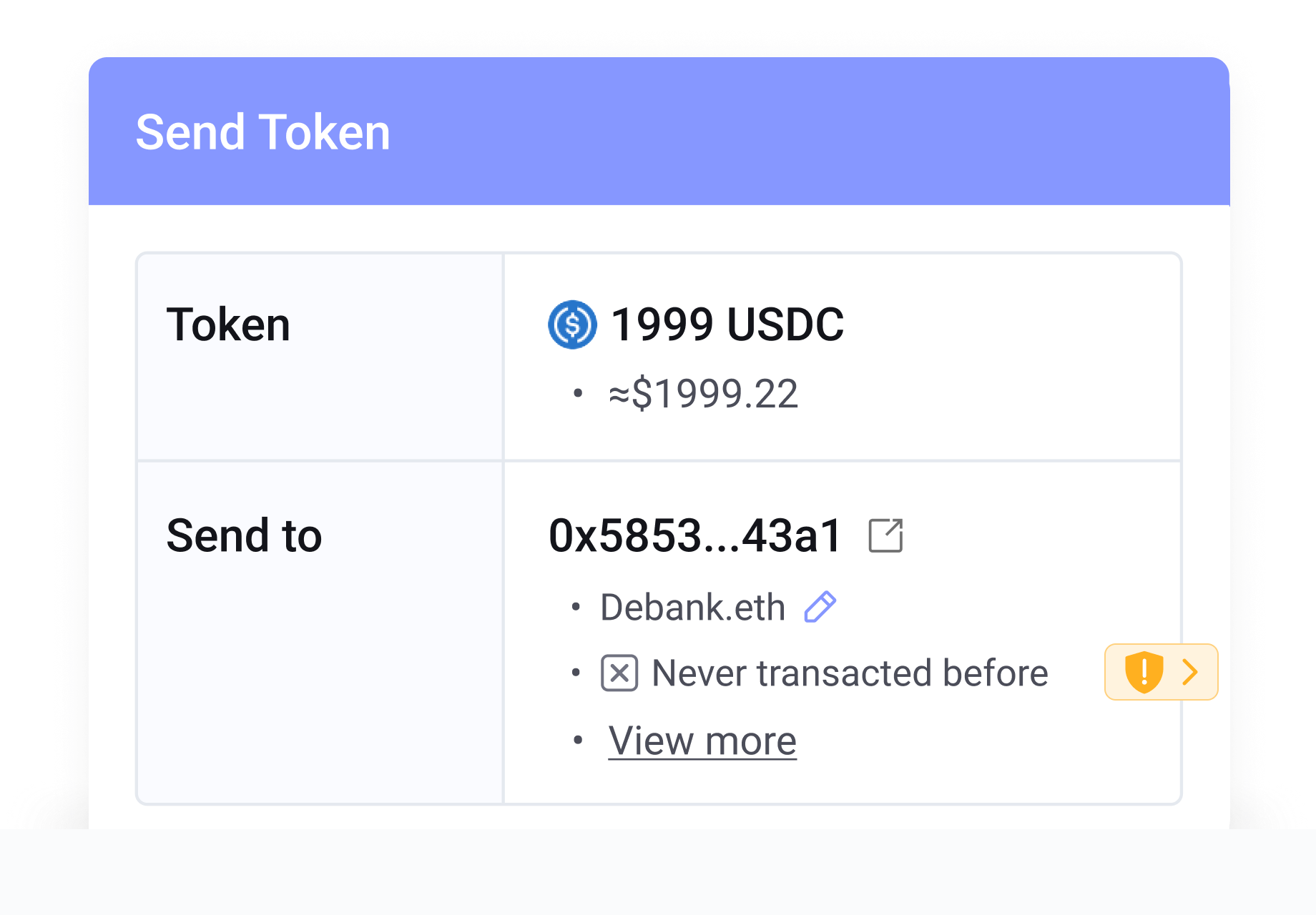
Mechanism first: what Rabby’s transaction simulation and pre-transaction scanning actually do
At the core: before you hit “confirm,” Rabby runs the pending transaction through a local or remote simulator and reports the expected changes — token inflows and outflows, recipient address, and the fee estimate. It also runs a security engine that flags known bad signs: interactions with contracts previously exploited, odd approval requests (e.g., full unlimited approvals), or non-existent recipients. For daylight operations, this is a direct countermeasure to blind signing, where users authorize transactions without a clear mapping from the signed data to its on-chain effects.
Why this matters mechanistically: smart contract ABIs can be dense and deceptive. A function name like “withdraw” could mask an internal transfer to a third party; a packed calldata may be unreadable to human eyes. Simulation translates opaque calldata into the thing humans care about — balances and token movements — so the human can make an economically rational decision. That changes the dominant error mode from “I trusted the UI” to “I misread the simulated output” — a smaller and more tractable failure class.
Security stack: the parts you should weave into operational discipline
Rabby is not a single silver bullet; treat it as a set of tools in a layered defense. The most relevant components for power users:
– Transaction simulation and pre-transaction scans — prevent blind signing and reveal suspicious patterns.
– Approval revocation — lets you cancel dangerous token approvals after the fact, reducing persistent exposure to contracts you no longer trust.
– Hardware wallet integration — Rabby supports Ledger, Trezor, Keystone and others, which moves the signing key out of the browser process.
– Multi-sig and institutional integrations — Gnosis Safe and custodial partners allow distributed approval policies for larger pools of capital.
– Automatic network switching — removes a common UX friction that causes accidental transactions on the wrong chain.
Combined into practice: use a hardware wallet for high-value moves, simulate every transaction on the extension, and keep a regular schedule (daily or weekly) to review approvals and revoke any unlimited or stale allowances. For institutional flows, put the largest pools of capital behind multi-sig and maintain distinct “hot” and “cold” operational wallets with clearly documented thresholds.
Where Rabby meaningfully shifts trade-offs — and where it doesn’t
Rabby’s simulation reframes the trade-off between convenience and control. Historically, wallet UX favored speed: click-to-sign made arbitrage and yield-farming fast but increased blind-signing risk. Rabby nudges the balance toward verification while preserving speed for experienced users because the simulation runs quickly and the extension automatically switches networks to match the dApp, eliminating manual context switches that used to slow traders down.
However, there are limits you must not conflate with complete protection. Simulation can show expected outcomes given current chain state and contract behavior, but it cannot guarantee invariant safety. If a contract’s logic depends on on-chain state that changes between simulation and execution, or if the dApp uses time-sensitive flashbots or MEV techniques, the simulation is only a snapshot. Simulation doesn’t stop front-running, miner-extracted value extraction, re-entrancy that unfolds during execution, or exploiting an on-chain oracle update that occurs between simulation and confirmed inclusion. In short: it mitigates blind signing but does not immunize you against all execution-time risk.
Another realistic limitation: Rabby currently lacks a built-in fiat on-ramp and native staking inside the wallet. For U.S. users, that means you’ll still need to move funds from regulated on-ramps or custodial exchanges into Rabby-managed addresses; those transfers create separate custody and counterparty choices you must manage. Also, while Rabby supports over 90 EVM-compatible chains — a major advantage for cross-chain DeFi — more chains mean more vectors; every additional chain introduces its own set of audited (or unaudited) contracts and bridges, so the mental bookkeeping load rises with scope.
Past incidents and how they shaped risk controls
Rabby’s response to a 2022 exploit of a related swap contract — freezing the contract, compensating users, and enhancing audits — is instructive. It highlights an operational truth: even teams with strong security practices can face contract-level failures because the majority of DeFi attack vectors exploit protocol logic rather than wallet keys. The practical implication is that wallet users should expect wallet makers to provide detection and mitigation tools, but must still maintain independent controls (separate accounts, approval hygiene, hardware keys) because protocol exploits can happen outside the wallet’s control.
Non-obvious insight: simulation flips the adversary’s optimization problem
Most attackers hunt for inattentive users who will sign without reading. Simulation moves attention from raw calldata to clear economic effects, forcing attackers to produce transactions whose economic outcomes look innocuous — a harder problem. Instead of crafting a function with confusing arguments, they must create a transaction that, at first glance, appears to transfer nothing or an expected amount while hiding a manifest transfer elsewhere. That raises the bar and nudges attackers toward earlier-stage compromises (phishing the seed phrase, infecting the extension) rather than relying on obfuscated transactions alone. But remember: attackers adapt. Phishing and social engineering remain primary risks and are unaffected by simulation itself.
Decision-useful framework: three checks to run before signing any transaction
Adopt this simple triage, usable in the browser as a habit:
1) Economically-meaningful check — does the simulated token flow match the intent? If you expected to swap 10 DAI for 0.005 ETH, are those numbers visible and consistent? Any divergence is a red flag.
2) Approval hygiene check — is the transaction requesting a new or unlimited approval? If yes, pause and consider revoking previous approvals or establishing a small-allowance pattern.
3) Contextual trust check — is the recipient a contract you recognize and trust? Has Rabby flagged this contract as previously exploited? If unknown, step back: verify the dApp’s contract address off-band (official docs, Etherscan) and, when in doubt, test with a tiny amount.
Use hardware wallets for the last 10% of assurance for large trades, and place the largest exposures behind multi-sig where practical.
What to watch next: signal set that would change how you use Rabby
Three developments should adjust your posture quickly: a) evidence of a systematic flaw in Rabby’s simulation engine (e.g., consistent mismatches between simulation and on-chain execution) would force you to revert to manual review and tighter hardware-wallet use; b) expansion of built-in fiat rails or native staking would reduce operational friction and change custody choices for U.S. users; c) increased adoption of authenticated, on-chain metadata standards for transactions (so dApps publish human-readable intent on-chain) would amplify simulation’s value by making simulated outputs easier to verify programmatically.
FAQ
Does Rabby eliminate the need for a hardware wallet?
No. Rabby’s simulation reduces blind-signing risk but doesn’t protect the private key if your browser or machine is compromised. For high-value transfers, using Rabby in combination with a hardware wallet remains best practice: Rabby shows what will happen, the hardware wallet signs it securely.
Can I safely use Rabby across many chains and dApps without increasing risk?
Using multiple chains increases exposure because each chain and its dApps bring different contract quality and bridge risks. Rabby reduces some operational risk (automatic network switching, consolidated approvals), but you still need chain-specific due diligence: limit approvals, use small test transactions on unfamiliar chains, and maintain separate wallets for different risk tiers.
How does Rabby compare to MetaMask for security?
Both are browser-accessible non-custodial wallets. Rabby differentiates itself by defaulting to transaction simulation, offering built-in approval revocation, and automatic network switching. MetaMask’s ecosystem is broader; Rabby’s approach reduces blind-signing risk more aggressively. The right choice depends on your workflow: if simulation and approval tools are central to your risk model, Rabby has an advantage.
Is Rabby open-source and auditable?
Yes. Rabby is open-source under the MIT license, which allows third-party audits. Open-source status helps community inspection but is not a substitute for independent audits and operational discipline.
For practitioners in the U.S. DeFi market, the core takeaway is a practical one: alter your signing habit, not just your tools. Use Rabby’s simulation as the first line of defense to spotlight the economic effect of transactions, pair it with hardware signing for high-value operations, and keep an approval-revocation routine. If you do those three things, you convert a large portion of routine wallet risk into manageable operational checks — and that is a meaningful improvement in the real-world security of active DeFi users.
For more detail on Rabby’s features and platform availability, see this resource: rabby
Sorry, the comment form is closed at this time.